

 Login
Chocolate tiles |
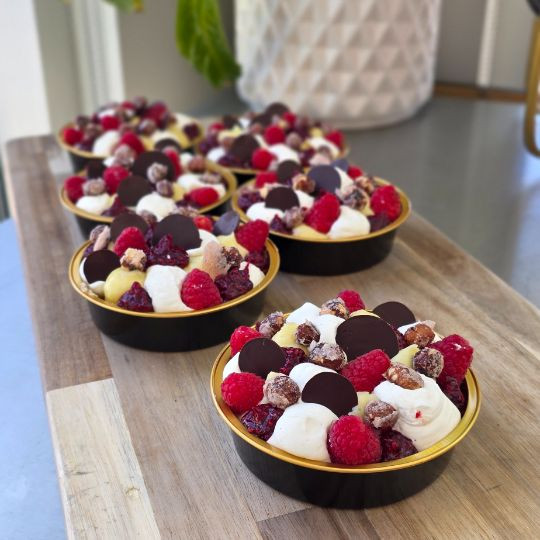
Three thin, crisp tempered chocolate plaques to use as a garnish or to accompany a dessert. Tempering gives the chocolate a glossy finish and helps it hold its shape at room temperature.
Keep all equipment completely dry: even a drop of water can cause the chocolate to seize. Before spreading each type of couverture, place a small smear on a spatula or a piece of acetate. If it begins to set within a few minutes without white streaks, the chocolate is in temper. Tempering curves vary slightly by couverture; follow the manufacturer’s curve when one is provided.
Ingredients
Recipe for 12 tapasDark chocolate tiles
Preparation time: 60 min
-
Mise en place
- Prepare three dry bowls, a rubber spatula, a thermometer, an offset spatula and clean, dry acetate strips. Lay the strips flat on a tray.
- Chop the three types of couverture separately. Temper one type at a time so you can spread it as soon as it reaches its working temperature.
-
Tempering the curves
Dark chocolate: melt to 50–55 °C; cool to 28–29 °C; work at 31–32 °C.
Milk chocolate: melt to 45–50 °C; cool to 27–28 °C; work at 29–30 °C.
White chocolate: melt to 45–50 °C; cool to 26–27 °C; work at 28–29 °C.
-
Tempering each chocolate
Melt 120 g of the chosen couverture in a bowl over a gentle bain-marie, stirring with a rubber spatula, until it reaches the melting temperature. The bottom of the bowl must not touch the water; avoid steam and condensation.
Remove the bowl from the bain-marie and dry its outside thoroughly. Add the remaining 80 g of chocolate to the warm chocolate and stir until completely melted. Cool the mixture to its crystallization temperature using the ribboning technique.
Rewarm the chocolate very gradually over the bain-marie, for a few seconds at a time, until it reaches its working temperature. Stir and check with a thermometer after each interval. Perform the setting test described in the chef’s tip.
-
Spreading and setting the plaques
Immediately pour the tempered chocolate onto the acetate strips. Spread it evenly with an offset spatula in a thin layer, about 1 to 2 mm thick. Keep the couverture at its working temperature as you spread it, without overheating it.
When the chocolate begins to set and is barely tacky to the touch, shape it as desired with a knife or a cutter. Do not cut through the acetate. Leave it to set completely on a flat surface in a cool, dry place, ideally at around 18–20 °C.
Carefully peel away the acetate, then separate the plaques along the scored lines.
Repeat the tempering and spreading process with the other two chocolates. Store the plaques in a sealed container, protected from moisture, heat and odours, with sheets of parchment paper between them.
Keep all equipment completely dry: even a drop of water can cause the chocolate to seize. Before spreading each type of couverture, place a small smear on a spatula or a piece of acetate. If it begins to set within a few minutes without white streaks, the chocolate is in temper. Tempering curves vary slightly by couverture; follow the manufacturer’s curve when one is provided.

Class with similar recipe

PASTRY CLASS
Modern seasonal fruit tart!
- Almond and caramelized apple tart base
- Creamy vanilla and mascarpone custard
- Apple, vanilla and cinnamon compote, apple spheres glazed and flambéed with ice cider |
- Salted butter caramel sauce |
- Chocolate tiles |
Share this unique and tasty
experience
Private and Corporate Events

Newsletter
Receive our tips, tricks as well as our verrrryyy gourmet meals plans!
Follow us!
Keep up to date with all
our news with our social media


A question?
Our teams are at your disposal from monday to friday from 10am to 6pm

